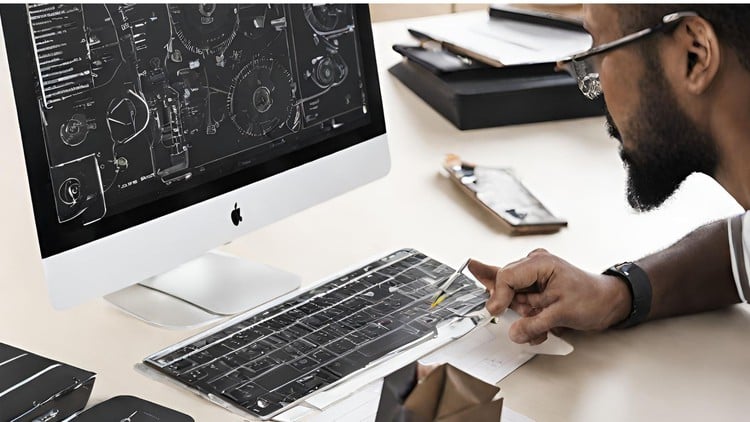
Job-Ready Skills for the Real World

Design career for Mechanical, electrical, electronics, systems and industrial engineering students. JJ/GE Best Practices
 Length: 4.0 total hours
 4.45/5 rating
 34,146 students
 August 2025 update
Add-On Information:
- Course Overview
- This Master’s program delves into the comprehensive journey of bringing innovative product ideas to life, from initial conceptualization through to tangible, functional prototypes ready for market validation. It provides a robust framework for integrating cutting-edge design principles with rigorous engineering development.
- Explore the strategic importance of a well-defined product development pipeline, emphasizing how systematic prototyping reduces risk, accelerates innovation, and ensures market relevance in today’s competitive landscape.
- Cultivate a holistic understanding of the product lifecycle, encompassing everything from user needs analysis and ideation to detailed design, material selection, manufacturing considerations, and iterative refinement.
- Learn to bridge the gap between abstract engineering concepts and consumer-facing products, developing a keen eye for both technical feasibility and aesthetic appeal that drives user adoption and satisfaction.
- Gain insights into real-world industry best practices, drawing upon methodologies proven by leading organizations, to develop products that are not just functional but also strategically superior and commercially viable.
- The curriculum is meticulously designed to transform theoretical knowledge into actionable skills, preparing you to tackle complex design challenges and lead innovation initiatives within diverse industries.
- Requirements / Prerequisites
- Candidates are expected to hold an undergraduate degree in a relevant engineering discipline, such as Mechanical, Electrical, Electronics, Systems, or Industrial Engineering, providing a foundational understanding of core scientific and engineering principles.
- A demonstrated aptitude for problem-solving and a genuine passion for creating innovative solutions are crucial, as the course heavily emphasizes practical application and creative thinking.
- While not strictly mandatory, a basic familiarity with technical drawing conventions or introductory computer-aided design (CAD) software will be beneficial for a quicker assimilation of advanced design tools.
- Applicants should possess a strong analytical mindset, capable of deconstructing complex problems into manageable design challenges, and a willingness to engage with both qualitative and quantitative data.
- An eagerness to collaborate in multidisciplinary teams and to embrace an iterative design process, where feedback and refinement are integral to success, is highly valued.
- Familiarity with fundamental manufacturing processes and material properties will provide a helpful context for understanding the constraints and opportunities in prototype development.
- Skills Covered / Tools Used
- Advanced Design Methodologies: Master user-centered design principles, Design for Manufacturability (DFM), Design for Assembly (DFA), Design for Sustainability, and value engineering techniques to optimize product attributes and production efficiency.
- Prototyping Technologies Mastery: Gain hands-on expertise with a diverse array of rapid prototyping methods, including various additive manufacturing processes (e.g., FDM, SLA, SLS 3D printing), subtractive manufacturing (CNC machining, laser cutting), and advanced molding techniques for functional testing.
- Simulation and Analysis Proficiency: Develop skills in using state-of-the-art Computer-Aided Engineering (CAE) tools for Finite Element Analysis (FEA) to predict structural integrity, Computational Fluid Dynamics (CFD) for performance, and kinematics analysis for mechanical systems.
- Industry-Standard CAD Software: Achieve advanced proficiency in leading 3D modeling and product design software packages (e.g., SolidWorks, CATIA, Fusion 360, Onshape), enabling the creation of intricate designs and detailed technical documentation.
- Design Project Management: Learn to apply Agile and Lean methodologies tailored for product development, manage design sprints, mitigate project risks, and effectively coordinate cross-functional design and engineering teams from concept to prototype delivery.
- Material Selection and Engineering: Understand the critical interplay between material science and product performance, learning to select optimal materials based on mechanical properties, cost, environmental impact, and manufacturing process compatibility.
- User Experience (UX) Integration in Physical Products: Explore principles of ergonomics, human factors, and sensory design to create products that are not only functional but also intuitive, comfortable, and aesthetically pleasing for end-users.
- Intellectual Property and Commercialization Strategy: Acquire knowledge of intellectual property rights (patents, trademarks), regulatory compliance, and market entry strategies to safeguard innovations and successfully transition prototypes into commercial products.
- Benefits / Outcomes
- Emerge as a highly skilled and sought-after product development specialist, equipped to innovate and lead in diverse sectors ranging from consumer electronics to industrial machinery and medical devices.
- Acquire the comprehensive expertise necessary to confidently lead multidisciplinary design and engineering teams, steering projects through complex challenges from initial concept validation to successful prototype realization.
- Unlock entrepreneurial potential by gaining the strategic and technical capabilities to conceive, design, and validate your own innovative product ideas, potentially launching new ventures with confidence.
- Develop a robust portfolio of tangible product prototypes and detailed design projects, showcasing your advanced skills and practical application of learned methodologies to prospective employers or investors.
- Gain a profound understanding of how to navigate the intricate product lifecycle, enabling you to make informed decisions that drive sustainable innovation and competitive advantage in global markets.
- Significantly enhance your problem-solving capabilities, applying a systematic and creative approach to overcome design constraints and technical hurdles in real-world product development scenarios.
- Contribute to the creation of impactful, user-centric, and environmentally conscious products that not only meet market demands but also set new industry benchmarks for design and functionality.
- Position yourself at the forefront of innovation, ready to adapt to emerging technologies and evolve design practices, ensuring long-term career relevance and growth in dynamic industries.
- PROS
- Highly Practical and Project-Oriented: The course is intensely focused on hands-on application, enabling students to immediately translate theoretical knowledge into tangible, working prototypes, fostering deep experiential learning.
- Leverages Industry Best Practices: Incorporates proven methodologies and insights from leading engineering and design firms (JJ/GE Best Practices), ensuring the curriculum is current, relevant, and directly applicable to industry demands.
- Strong Career Advancement Potential: Designed to elevate engineering professionals into leadership roles in product innovation and development, offering a distinct competitive advantage in the job market.
- Fosters Entrepreneurial Acumen: Provides the essential toolkit for aspiring entrepreneurs to develop, validate, and potentially commercialize their own product ideas, from concept to prototype.
- High Student Satisfaction & Engagement: Evidenced by a strong rating and large student enrollment, indicating a successful and engaging learning experience that resonates with participants.
- Comprehensive Skill Set Development: Covers the entire spectrum of product design, development, and prototyping, equipping graduates with a holistic understanding and versatile capabilities.
- CONS
- Significant Time and Resource Commitment: Mastering the advanced design methodologies, complex software tools, and practical prototyping skills requires a substantial dedication of personal time, effort, and potentially additional resources for hands-on projects beyond the core course material.
Learning Tracks: English,Business,Entrepreneurship

Found It Free? Share It Fast!
The post Master in Product Design, Development and Prototyping appeared first on Thank you.