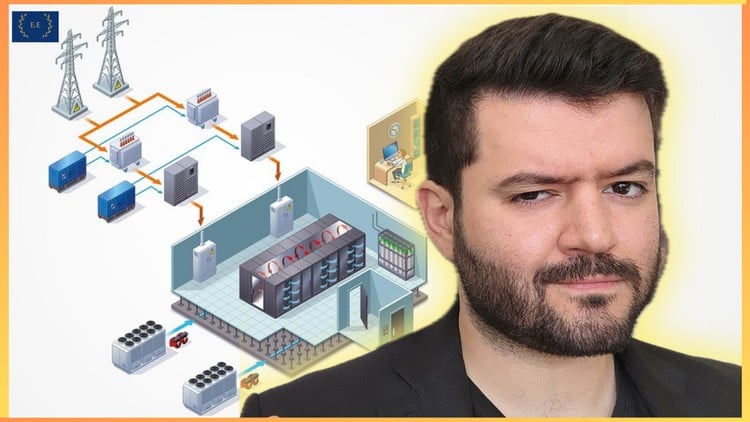
Job-Ready Skills for the Real World

Data Center Electrical Design Engineering/Data Center Electrical Infrastructure/Data Center Power Infrastructure (A-Z)
 Length: 3.0 total hours
 4.44/5 rating
 5,091 students
 April 2025 update
Add-On Information:
-
Course Overview
- Embark on a comprehensive journey into the intricate world of data center electrical infrastructure, focusing on the core principles and practices that underpin reliable and efficient power delivery in mission-critical environments. This course illuminates the entire lifecycle of power within a data center, from the utility grid demarcation to the server rack.
- Explore the foundational elements of electrical design philosophy for data centers, emphasizing the paramount importance of resilience, redundancy, and scalability. Understand how design choices impact operational uptime and the total cost of ownership over the facility’s lifespan.
- Gain insight into the strategic considerations behind selecting appropriate power distribution architectures, including centralized vs. decentralized approaches, and their respective implications for flexibility, maintenance, and future expansion capabilities.
- Uncover the evolution of power management strategies within modern data centers, from traditional static systems to dynamic, intelligent power solutions that adapt to fluctuating IT loads and optimize energy consumption in real-time.
- Appreciate the critical interplay between electrical systems and other data center domains, such as cooling, physical security, and network infrastructure, understanding how power decisions ripple across the entire operational landscape.
- Delve into the economic drivers and environmental imperatives influencing sustainable data center power design, including approaches to lower carbon footprints and achieve higher energy efficiency ratings without compromising performance.
- Understand the significance of regulatory compliance and industry standards, grasping how adherence to established guidelines ensures operational integrity, mitigates risks, and facilitates international interoperability in data center services.
-
Requirements / Prerequisites
- Possess a fundamental understanding of basic electrical concepts such as voltage, current, resistance, and power, as typically covered in an introductory physics or engineering course.
- Demonstrate an interest in critical infrastructure operations, IT systems, or facility management, showcasing an eagerness to learn about the underlying physical components that support digital services.
- No advanced engineering degree or specialized electrical certifications are required; however, a logical problem-solving aptitude and attention to detail will greatly enhance the learning experience.
- Familiarity with general IT terminology and data center components at a high level will be beneficial, though not strictly mandatory, to contextualize the electrical discussions within a broader operational framework.
- Access to a standard internet-connected device (computer, laptop, or tablet) capable of streaming video and accessing digital course materials is essential.
-
Skills Covered / Tools Used
- Develop proficiency in conceptualizing and interpreting various power redundancy schemes (e.g., N, N+1, 2N, N+2), understanding their impact on reliability, cost, and complexity within a data center setting.
- Acquire the ability to perform basic electrical load balancing and capacity planning exercises, ensuring that power resources are allocated efficiently and future growth can be accommodated without system overloads.
- Gain insights into the principles of effective grounding and bonding strategies, crucial for ensuring safety, preventing electrical noise, and protecting sensitive equipment from surges and faults.
- Learn about various surge protection devices and strategies (SPDs) and their application in safeguarding critical electrical pathways and IT equipment from transient voltage spikes.
- Understand the fundamentals of fault current analysis to assess potential short-circuit scenarios and design protective devices that rapidly isolate faults, minimizing damage and maintaining system integrity.
- Explore the role of electrical safety protocols and lockout/tagout (LOTO) procedures specific to data center environments, emphasizing personnel protection during maintenance and operational activities.
- Interpret and critically evaluate single-line diagrams (SLDs) and power distribution schematics, a foundational skill for understanding existing infrastructure and planning future modifications.
- Examine the key parameters for selecting appropriate electrical conductors, circuit breakers, and protective relays based on load requirements, fault current ratings, and environmental conditions.
- Become familiar with the concept of power quality metrics (e.g., harmonics, voltage sags, swells) and their impact on data center operations, along with methods for mitigation.
- Develop an understanding of how to conduct preliminary risk assessments for power-related failures and devise strategies for mitigation and disaster recovery within the electrical domain.
-
Benefits / Outcomes
- Cultivate a holistic and nuanced understanding of the entire electrical ecosystem within a data center, enabling you to identify potential vulnerabilities and propose robust solutions proactively.
- Enhance your strategic decision-making capabilities regarding electrical infrastructure investments, ensuring alignment with business objectives, budget constraints, and long-term operational goals.
- Gain the confidence to engage in knowledgeable discussions with electrical engineers, facility managers, vendors, and consultants, effectively communicating requirements and evaluating proposed solutions for power systems.
- Position yourself as a highly valued professional capable of contributing significantly to the resilience and operational continuity of organizations reliant on critical IT loads.
- Contribute directly to achieving substantial energy cost savings and improved operational efficiency through informed design, selection, and management of data center power components.
- Improve the overall operational resilience and uptime of mission-critical systems by understanding the best practices in power system redundancy, maintenance, and fault prevention.
- Foster a proactive mindset toward anticipating and mitigating potential power-related issues before they escalate into costly outages or system failures.
- Grasp the significant role that efficient and sustainable power infrastructure plays in helping organizations meet their corporate social responsibility and environmental sustainability goals.
- Lay a strong foundational knowledge base for pursuing advanced certifications or further specialized studies in areas such as data center design, energy management, or critical facilities engineering.
- Elevate your professional profile and open doors to new career opportunities in a rapidly evolving and highly specialized sector of the IT and infrastructure industries.
- Develop a keen analytical eye for evaluating the effectiveness and potential weaknesses of existing power setups, enabling you to recommend targeted improvements for enhanced performance and reliability.
- Equip yourself to critically assess and validate proposals for new power system installations, upgrades, or technology migrations, ensuring they meet both technical specifications and business needs.
-
PROS
- Delivers highly relevant and in-demand knowledge critical for professionals in the rapidly expanding data center industry.
- Provides practical, actionable insights into power infrastructure that can be applied immediately to real-world challenges.
- Serves as a significant career booster, enhancing specialization and opening up opportunities in a niche yet vital field.
- Offers a clear, structured learning path, making complex electrical topics accessible and digestible for diverse professional backgrounds.
- Focuses on industry best practices and innovative solutions, ensuring learners are equipped with contemporary and forward-looking skills.
- Promotes a deeper understanding of reliability, efficiency, and safety, which are paramount in critical infrastructure operations.
-
CONS
- Given the broad scope implied by “A-Z” and the total course length, some highly specific or deeply practical “hands-on” aspects of electrical engineering might be presented at a conceptual level rather than through extensive detailed exercises, potentially requiring self-study for mastery.
Learning Tracks: English,IT & Software,Network & Security

Found It Free? Share It Fast!
The post Data Center Infrastructure: Electrical & Power Essentials appeared first on Thank you.