Job-Ready Skills for the Real World

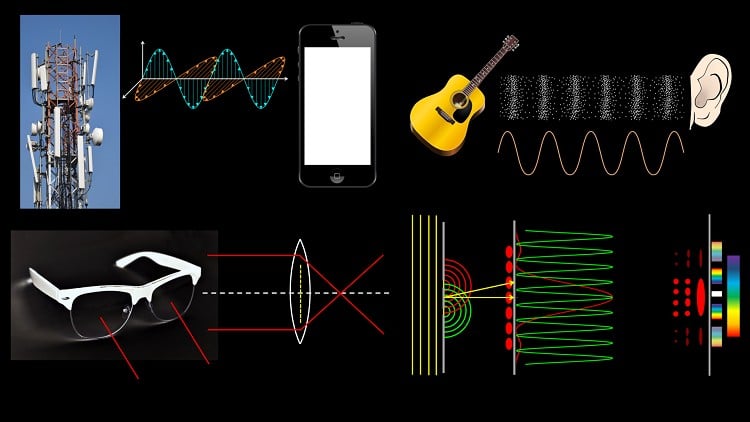
Light, sound, Huygens-Fresnel, polarisation, reflection, refraction, diffraction, beats, interference, Doppler, film
What you will learn
Understand the properties and behaviour of waves, including electromagnetic and sound waves
Use the Huygens-Fresnel principle to describe the reflection of light from a surface, including diffuse and specular reflection
Use ray diagrams to describe the images formed by a mirror due to the reflection of light
Use Snell’s law to describe the refraction of light through a surface and total internal reflection
Use ray diagrams to describe the images formed by a lens due to the refraction of light
Understand the difference between waves and pulses and their properties like wavespeed, amplitude and energy
Understand the difference between longitudinal and transverse waves
Describe the properties of periodic waves, including period, frequency and wavelength
Describe the behaviour of waves at boundaries and how the polarisation of electromagnetic waves influences intensity using Malus’ law
Interpret the electromagnetic spectrum and derive the energy density of electromagnetic waves
Explain the Doppler effect by analysing sound waves propagating from a moving object
Understand wave interference and how it results in the formation of beats and standing waves
Describe the diffraction of light using a single-slit and Young’s double-slit experiment, and the influence of diffraction grating
Understand the phase change of light, and thin-film interference and its applications
English
language

Found It Free? Share It Fast!
The post A Solid Foundation in the Physics of Waves, Sound and Optics appeared first on Thank you.